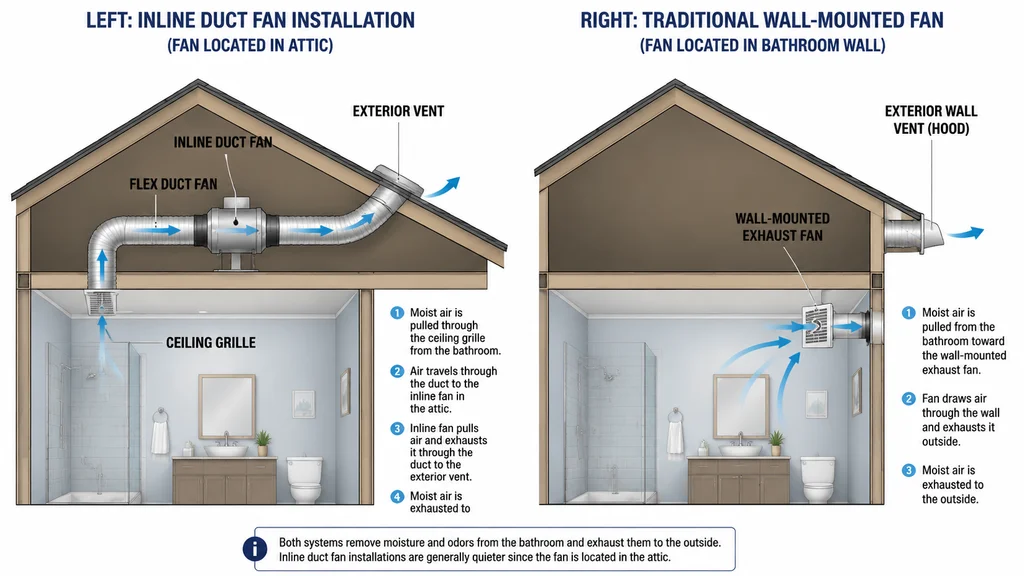
An inline fan (also called an inline duct fan or remote-mounted fan) is a ventilation device installed directly within ductwork, typically in an attic, crawlspace, or mechanical room. Unlike traditional exhaust fans that mount flush to a wall or ceiling, inline fans sit “in line” with the air ducts—hidden from view but powerful where it counts.
Inline fan vs traditional wall-mounted fan
How Inline Fans Work
Inline fans create negative or positive pressure within the duct system to move air efficiently from one space to another. When used for exhaust, they pull stale, humid, or contaminated air from rooms through ducts and expel it outside.
Inline Fan vs. Wall-Mounted Fan
Feature
Inline Fan
Wall-Mounted Fan
Installation Location
Inside ductwork (attic, crawlspace)
Directly in wall or ceiling
Noise Level
Low (1-2 sone)
Moderate to high (3-5 sone)
Airflow Capacity
High (100-1000+ CFM)
Limited (50-150 CFM)
Duct Length Capability
Excellent (50+ ft)
Poor (struggles beyond 15 ft)
Cost
Higher ($100-$400)
Lower ($30-$150)
Types of Inline Fans
The three main types—axial, centrifugal, and mixed-flow—use different internal designs to move air.
Axial, Centrifugal, and Mixed-Flow fans
Axial Inline Fans
Axial fans use propeller-style blades that push air parallel to the motor shaft. They excel in high-volume, low-pressure scenarios over short ducts.
CFM Range: 100-500
Static Pressure: Low (0.1-0.3 inches)
Best For: Short ducts (<25 feet), simple exhaust
Price Range: $50-$150
Centrifugal Inline Fans
Centrifugal fans use a squirrel-cage impeller that builds much higher pressure, ideal for long ducts or complex duct layouts.
CFM Range: 150-1000+
Static Pressure: High (0.5-1.5 inches)
Best For: Long ducts (25-100+ ft), multi-room systems
Price Range: $150-$400
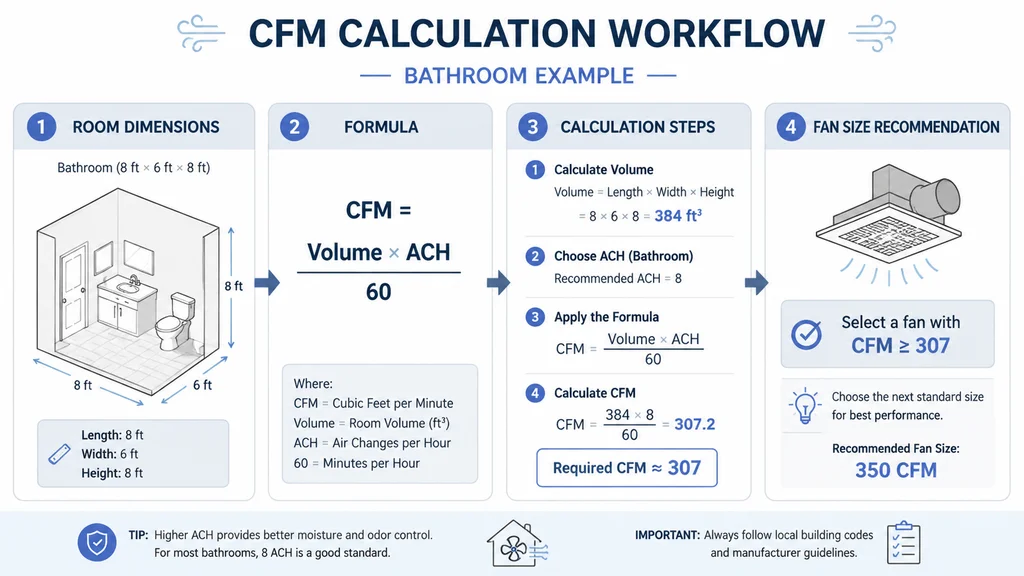
How to Size an Inline Fan: CFM Calculation
CFM calculation workflow
The key metric is CFM (Cubic Feet per Minute). Use this formula:
CFM = (Room Volume × Air Changes per Hour) / 60
Example: Standard Bathroom
Room: 8′ × 6′ × 8′ = 384 cubic feet
ACH: 8 (bathroom standard)
CFM = (384 × 8) / 60 = 51 CFM
Recommended fan: 80 CFM
Room Size
Volume
CFM Required
Recommended Fan
5′ × 8′ × 8′
320 cu ft
43 CFM
50-80 CFM
8′ × 10′ × 8′
640 cu ft
85 CFM
110 CFM
10′ × 12′ × 9′
1,080 cu ft
144 CFM
150-200 CFM
🧮 CFM Calculator
Calculate the fan size you need:
Room Volume:384 cu ft
Required CFM:51.2 CFM
👉 Recommended:80 CFM
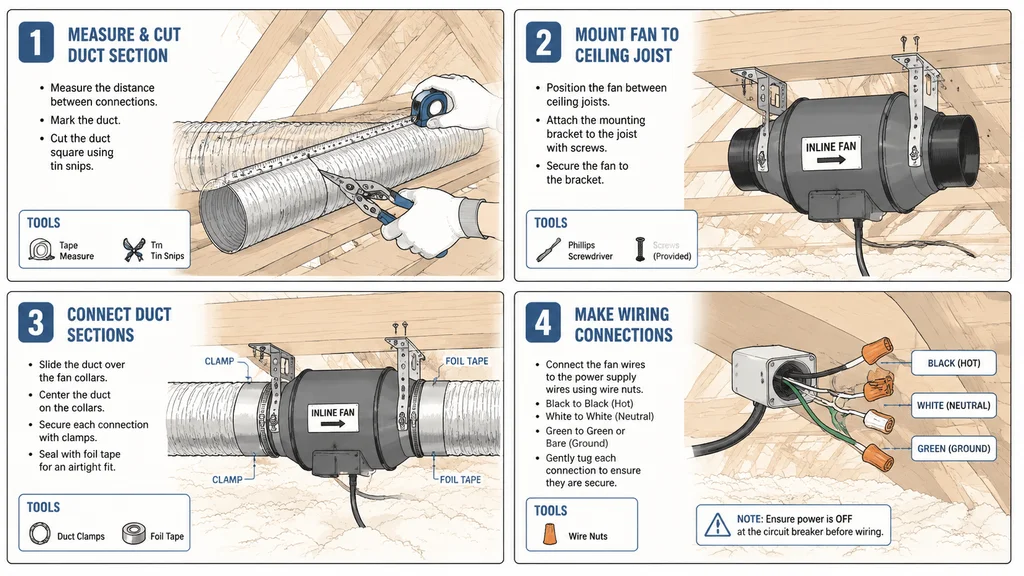
Inline Fan Installation Guide
Step-by-step installation guide
Tools Needed
Tin snips or reciprocating saw
Drill/driver with bits
Wire cutters and strippers
Aluminum foil tape (NOT cloth duct tape)
Voltage tester
Installation Steps
Step 1: Cut the Duct Section Measure and cut the duct cleanly where the fan will sit.
Step 2: Mount the Fan Orient the fan correctly (arrow points toward exhaust). Secure to joist/rafter with mounting bracket.
Step 3: Connect Ductwork Use duct clamps and aluminum foil tape for airtight seals.